
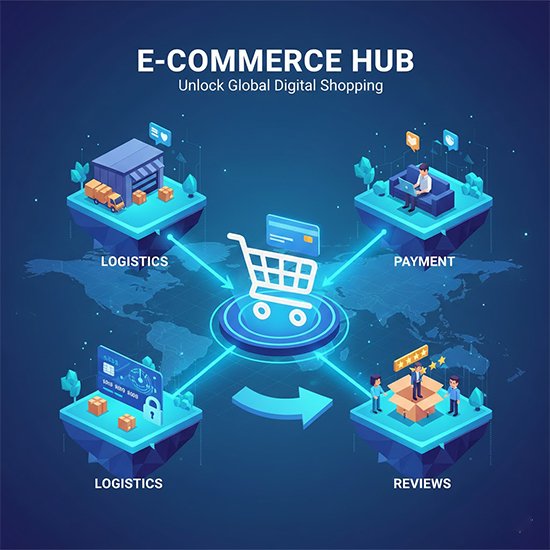
Description
E-commerce solutions can be broadly categorized in two main ways: by the underlying technology/platform and by the business model they support.
- E-commerce Platforms (The “How” You Build It)
This refers to the software you use to build and manage your online store. They typically fall into three main types:
- Software as a Service (SaaS) Platforms
These are all-in-one, cloud-based solutions where the provider hosts the software and handles updates, security, and maintenance. They are the easiest and fastest way to make a starting.
| Platform Type | Best For | Key Examples |
| SaaS (Hosted) | Startups, small to medium businesses, and those who want ease of use without worrying about coding or hosting. | Shopify, Wix, Squarespace, BigCommerce |
| Pros | Very easy to set up, minimal maintenance, excellent support, robust features out-of-the-box (payments, checkout). | |
| Cons | Less control over the underlying code, monthly subscription fees, customization can be limited to available themes and apps. |
-
Open-Source Platforms
These solutions offer the underlying software code for free, giving you complete control and flexibility. However, you are responsible for hosting, security, and all technical maintenance.
| Platform Type | Best For | Key Examples |
| Open-Source (Self-Hosted) | Businesses already using WordPress, those with in-house development teams, and stores requiring deep, custom functionality. | WooCommerce (a WordPress plugin), Magento (now Adobe Commerce), PrestaShop |
| Pros | Complete control over code, unlimited customization, no platform transaction fees (though hosting and developer costs apply). | |
| Cons | Requires technical expertise (IT/developer), higher initial and ongoing maintenance costs, you manage hosting and security yourself. |
-
Headless / Composable Commerce
This is an advance level architecture where the “head” (the frontend—what the customer sees) is separate or decouple from the “body” (the backend, which handles inventory, orders, and payments).
| Platform Type | Best For | Key Examples |
| Headless (API-Driven) | Large enterprises, multi-channel brands, or those needing highly personalized, non-traditional storefronts (like kiosks, apps, or smart devices). | commercetools, Contentful, Shopify Plus (headless option) |
| Pros | Maximum flexibility to create unique user experiences across any device, unparalleled scalability. | |
| Cons | Highest complexity, requires significant developer expertise, and the highest cost. |
-
E-commerce Business Models (The “What” You Sell)
E-commerce solutions are also defined by the type of relationship and transaction they facilitate:
| Business Model | Definition | Example |
| Business-to-Consumer (B2C) | A business sells products or services directly to the final consumer. | An online clothing boutique selling shirts to shoppers. |
| Business-to-Business (B2B) | A business sells products or services to another business (e.g., a wholesaler selling bulk goods to a retailer). | A factory selling 1,000 components to an assembly company via an online portal. |
| Consumer-to-Consumer (C2C) | Consumers sell directly to other consumers, usually through a third-party marketplace. | eBay, Etsy, Facebook Marketplace. |
| Direct-to-Consumer (D2C) | A manufacturer or brand sells their products directly to the consumer, bypassing traditional retailers. | A sneaker brand selling only through their own website. |
| Dropshipping | The store owner sells a product but doesn’t hold the inventory; a third-party supplier ships directly to the customer. | A Shopify store listing products from a Chinese supplier. |
The “best” e-commerce solution is the one that aligns with your budget, technical skill level, and business model.
Contact us for E-Commerce solutions that suits your business and budget. Comparatively faster results as well as reply.
There are no reviews yet.